When mass media publish articles about retirement, I often find comments from real-world retirees more helpful than whatever the “experts” say.
Thus is the case for the New York Times’ “Is Retirement Unhealthy? It Depends.”, which didn’t offer much helpful or new on the topic. For example, one of its key points: “People need to realize that the type of retirement they experience grows out of the type of life they have lived. Learning to be curious about the world, volunteering to help others and developing friendships has to start much earlier than 65.”
Well, yes, to a point. But people can still learn – or improve – those things at any age. The “It Depends” part of that headline is so important that you’d need a lot more than a short newspaper article to cover it all.
So I quickly headed to the reader reactions. One of the more interesting comments came from Nigel Searle, who wrote: “I retired 17 years ago, when I was 63. It’s my belief that nothing you do will make you happy if you haven’t first figured out how to be happy doing nothing.”
Bingo.
There’s so much focus on creating “purpose” in our retirement, and all that we need to fill our time with, that relaxing can get left behind. And by “relaxing”, I don’t mean “recover from a grueling week.” I mean truly appreciating what the Italians call dolce far niente: the sweetness of doing nothing.
Related: Breaking Free from the Tyranny of ‘Purpose’
“For something that sounds so simple, leisure can be surprisingly difficult,” Rafaela Jinich wrote in an Atlantic newsletter this summer, rounding up several of their articles on the topic. “Maybe that’s because leisure feels worthwhile only when it accomplishes something - if a walk counts as exercise, a hobby builds a skill, or a vacation leaves us recharged enough to work harder when we return.”
And maybe that’s one of the issues for people who don’t like retirement. Along with missing work structure, validation, and community, another challenge (for people not burdened with health issues or caregiving responsibilities) may be having too much free space in their schedules. Because Jinich is right: Our culture has come to view even time off as something that should support your ability to work more.
What happens when there isn’t any work to justify our free time?
Some of us are thrilled. Others feel a little unmoored until crafting our new lifestyle. But I think there are also people who either don’t know how or don’t want to enjoy large amounts of guilt-free leisure.
Idleness is not something America admires.
Yet “leisure is doing things for their own sake, to pursue what one wants. We should fight the urge to reduce it to a productivity hack,” Krzysztof Pelc wrote during the height of the pandemic in Why Your Leisure Time is in Danger. “Leisure should be aspired to for no other reason than that it is possible.”
If you want a frenetic retirement with a schedule as packed as when you were working, that’s great if it makes you happy! There are definitely people who thrive that way.
I’ve had some days like that in my retirement, even some weeks. And they’ve often made me happy. But I try not to make that every day and every week. I also want to value my leisure.
I think we should all try to figure out the busy/leisure balance we really want, and not simply follow cultural cues that glorify being busy and devalue leisure time.
“What is workism? It is the belief that work is not only necessary to economic production, but also the centerpiece of one’s identity and life’s purpose; and the belief that any policy to promote human welfare must always encourage more work,” Derek Thompson wrote in “Workism Is Making Americans Miserable. “Americans have forgotten an old-fashioned goal of working: It’s about buying free time.”
It can be unsettling after decades of not having enough time to suddenly have massively more unscheduled hours in retirement. Not every retiree ends up with a lot of extra time; but for those who do, the question is often: What now?
The modern era has given us technology that will happily fill the void, whether social media doom scrolling or endless streaming. Even those of us who grew up before cable TV and the World Wide Web, let along smartphones and Netflix, may be a bit out of practice with schedule-free, tech-free blocks of time. And I think this will only get harder for the generations after us.
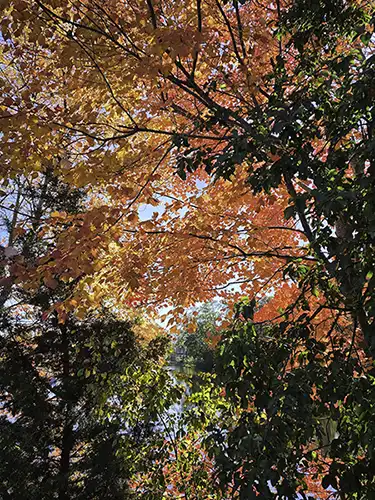
Purpose shouldn’t be confused with productive in the capitalist sense of the word. Are my blogs “productive?” I don’t make any money from them; I just like to write. Was my hike on a local trail “productive?” It might have counted as exercise; but in addition to brisk walking, I also meandered and stopped to admire some breathtaking fall colors.
So yes, I very much want to follow advice to maintain my social connections and find meaning in things I do with some of my time. But it’s also fine to have long stretches when I read for pleasure, take leisurely walks, or just stare at the autumn leaves for awhile.
Another commenter on that NYT article wrote: “I had a high-intensity career; I enjoyed it, but it was the sort of thing that can eat people alive. When retirement time came, I stepped away from it, handed it over to other people, and went my merry way.”
And now? “I do what I want, when I want to, and that’s the ‘purpose’ I have.”
You can follow My Next Chapter by email newsletter or RSS feed. Blog content © Sharon Machlis.